Your Sacred Space: Part Two of an Interview with Trudy and Women on Fire Founder Debbie Phillips

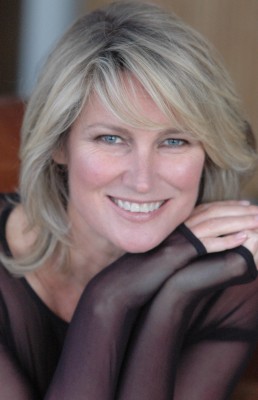
Debbie Phillips

This is part two of my interview with Debbie Phillips for Women on Fire, the group she founded to bring an amazing circle of fabulous women together for inspiration, strategies and support.  The following is a transcript of part two of our talk on Your Sacred Space:  How to Create an Inspired, Healthy Living Environment. Read Part One here

continued…

Trudy:  What I’m striving for is indoor air quality–whatever we put in that space.  And the only space you can really control is your own environment, your home, so that everything in there supports your health and wellbeing.

Debbie:  Right.  Well, I love that notion, and I’m sure that people listening are thinking, “Well, how can I control other environments?”  But like you said, we can control our homes.  We can also control our cars, and some of us can control our offices.  Is there any way, Trudy, to control other environments–short of wearing a mask?

Trudy:  I think a lot of it is education, and you know I’m big on that.  I’m always trying to promote how to support yourself at home through my blog and also in the lectures I do on The Holistic House.  People ask, “Where should I begin?”  Begin in the nursery because your baby is sleeping in there 20-24 hours a day and breathing in that air.  But your own bedroom needs to be almost like a bell jar–really clean and free of dust and dust mites.  Don’t have a lot of wall-to-wall carpeting because there is so much that gets trapped underneath there.

Debbie:  Really?

Trudy:  Oh, yes, microbial growth.  At least area rugs can be sent out and steam cleaned.

Debbie:  Interesting.  So choose hardwood floors and rugs over wall-to-wall carpet.

Trudy: Hardwood floors, tile floors, stone floors–those are the cleanest.  They are the easiest to keep clean and dust-free.  When people who are really allergic or who have asthmatic children come to me, I tell them to damp mop their floors–as if we have enough free time to do all this.  But try to damp mop floors twice a week.  It is believed that our livers detox somewhere between 2:00 and 4:00 a.m.  Your liver and your kidneys are really hard at work, so you want to sleep in a really clean environment so you’re not still taxing your system and your organs.

Debbie:  Trudy, I’ve seen those air filters that often can be bought at specialty stores.  is there any kind or a particular air filter that you would recommend?

Trudy:  As you know, I had such a struggle with chemical sensitivity.  I had to go through a two-year detox program, which was almost like being on chemotherapy.  It was really rough.  So I don’t want to see other people go through that.  The one filter that the environmental physicians–there are only 400 in the whole world; it is a very specialized group–like is the Austin HealthMate Plus.  And the reason for that, Deb, is that it has a HEPA filter in there to filter out particulates–dust, mold spores, animal dander, pollen in the spring.  But it also has zeolite in the carbon filtration, which filters out vapors such as car fumes.  If you have a garage that’s part of your house, car fumes can infiltrate and go right through all the little perforations into the house.  The Austin HealthMate Plus filters out all of that.  It will filter out and lower the VOCs from your furniture because all furniture finishes have VOCs.  So that’s the filter I swear by.

Debbie:  That’s great.  Is there a particular kind of mattress or pillow or bedding?  I know it should be from organic cotton, but is there any particular brand or style that you think is best?

Trudy:  There are so many out there, so I want to tell everybody:  Buyer beware.  Make sure you really go to someone who can say that a mattress is truly organic cotton or it’s truly organic wool because it has been certified.  I personally like a wool mattress that’s been tufted, and then I have it encased in organic cotton.  I get my physician to write me a prescription slip, so to speak, to give to the people making the mattresses, saying that i refuse to have it sprayed with fire retardant.  By law, they have to add fire retardant in case there is a smoker in bed and a cigarette is dropped.  But it’s a problem because the rest of us have to pay the price by sleeping on a bed immersed in that chemical, and you really don’t want that.

Debbie:  Wow.

Trudy:  The other thing you want to do–because dust mites and the little things they leave behind are what a lot of people are allergic to, especially asthmatic children–is to get an encasement, a completely zip-around mattress protector.  It’s not just a pad on the top, and it’s made out of barrier cloth.  That keeps out dust mites, bed bugs, all those things that can happen, and you are much safer.  Your pillow really shouldn’t be foam or anything made of a chemical.  it should be organic cotton or organic wool, again, in an organic-cotton encasement protector.

Debbie:  Is there anything around the waterproofing of a mattress pad?  Would that necessarily have chemicals in it?

Trudy: It could.  Until I look at the label, I wouldn’t know.  You have to be careful of chemicals, especially where you are sleeping at night.  That’s the one room to change.  People say, “I can’t afford to go through and change my whole house.”  And I completely relate to that. But try to make your bedroom as clean, organic and chemical-free as possible.  That’s the goal.

Debbie:  This is so helpful because one of the things Rob and I have done is to create a couple’s sanctuary, but we have not gone to this level. This is very inspiring.  I want to talk about something else that would potentially be a tip, Trudy, and that is because we are talking about an inspired environment with a strong emphasis on creating a healthy environment.  I want to tell you a quick little story.  When I met Rob, who is now my husband, he had this rule that one way to create a sacred environment was that all shoes were to be removed before entering the house.  it took me a little while to get used to that, but I have adopted his ways and I have to say that I love it.  And, Trudy, you are the only other person I’ve met who has a porch full of shoes. I wondered if that’s a rule at your house–a shoeless house–and is there a good reason for not wearing shoes in the house?

Trudy: Absolutely.  I think it’s sacred.  It’s respectful to remove your shoes, to not bring in all that stuff from the street.  Asians do that a lot.  But there is also a very scientific reason for it:  When we are walking around on the street, we are actually walking through viruses, bacteria, chemicals sprayed on the streets to melt ice, and all of that.  We walk through that, and we definitely don’t want to track it into the house.  People I’ve studied with have said that if you could make pesticides iridescent and if you used a black light on them, they would glow.  And if you had somebody walk through his yard after it was sprayed for ticks or mosquitoes or whatever and then you tracked him as he walked through the house, there would be footprints everywhere he went in the house.  So that’s your practical reason.  Let’s not bring all this inside.  My biggest pet peeve is pesticides, chemicals, insecticides, mildewcides, and all of that.  I understand the purpose of it and I know what people are trying to do, but I think the public doesn’t always know the horrible side effects of it.

Debbie:  Right.  It’s funny, but I wonder if you have had this experience:  both of our homes on Martha’s Vineyard and Naples are shoeless, but I still feel a little embarrassed asking people to remove their shoes. 

Trudy:  You know what I do?

Debbie:  What do you do?

Trudy:  I go to Rite Aid and buy the little cotton socklets in all sizes, and I leave them right there at the door because sometimes people don’t want to slip on slippers if they feel that somebody else’s feet have been in there.  I relate to that.

Debbie:  I do too.

Trudy:  So get a fresh, sealed bag of little socklets, and you can get the ones that the men don’t mind wearing.  They’re almost like the little things they give you in the hospital when you’re walking up and down the halls.  And that just covers it when they’re in your home, and they can choose their colors.  Then it becomes sort of fun.

Debbie:  What a great idea.  Thank you, Trudy.  That solves that problem.  What are some other ways to detox our homes or space?  And, by the way, I hear a lot about that.  People will talk about, “I’m going to clear or detox my space.”  Is there an appropriate way to clear and detox a home?

Trudy: The biggest thing is what you put in it.  Let’s say you’re painting.  There was some wonderful person who sent me an email this morning, “How do you choose your paint?” I wasn’t sure if she was asking about color or if she wanted to know how to choose a safe paint.  For the latter, the biggest thing you can do, if you know you have oil-based paint and you’r’e going to repaint, is to go to a low-or no-VOC–again, Volatile Organic Compound–water-based latex paint.  Oil paint is a petroleum product.  People say, “Oh, my house doesn’t smell anymore.  I painted it three months ago.”  If you could dye those VOCs purple, you would see that they go on forever.  It’s truly deleterious to your health.  It’s truly injurious.  It’s not good for your lungs.  It’s just not good for a lot of reasons.

Debbie:  Do the major paint companies make those or do you have to find a special company?

Trudy: They do.  And so you don’t have to spend a fortune for that.  If you don’t have a chemical sensitivity, you probably don’t have to go as far as I do with it for my own health.

Debbie:  You were referring to a question from Jill Dulitsky, from Vernon, Connecticut.  She asked, ‘We are redoing our house and making a much more open floor plan.  How do you choose paint?”

Trudy: I emailed her back so we will continue that discussion, for sure.

Debbie:  I don’t know whether she did mean color.  Melissa McClain from Seattle, Washington, is very into color, and we should just bring up the color issue since I’m not sure what Jill meant.  Melissa asks, “What is your philosophy on finding the perfect color for your home or room?”

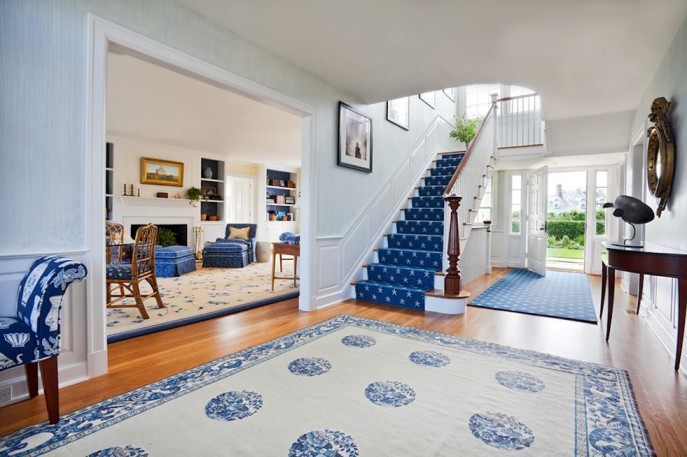
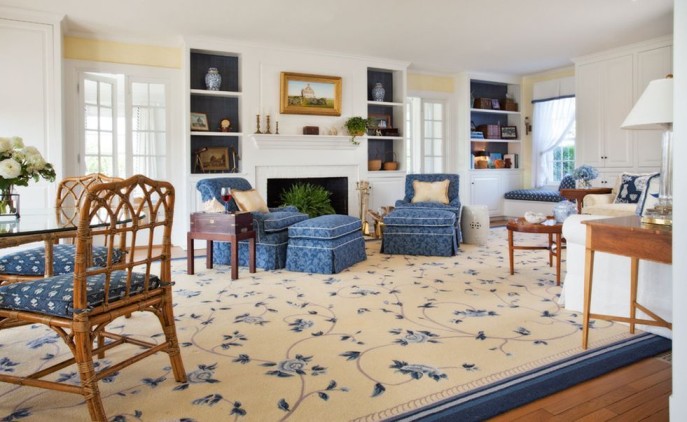
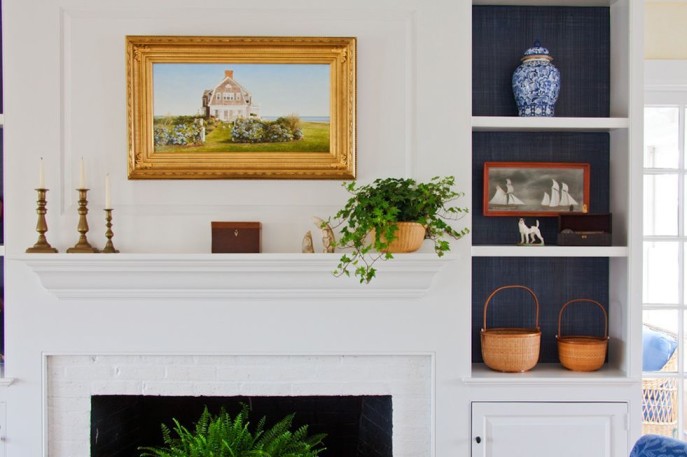
Trudy:  It’s really client-driven.  After I sit and talk with clients, I get a feel for what they like.  I also give them a client questionnaire.  It’s long.  I ask them, “What are your favorite colors?  What colors do you hate?” I tell them to get five of the current shelter magazines and tear out pages and write on them, saying, “Trudy, I love this.  I hate that.” By the time we’ve spoken and they’ve filled that out and I look at their tear sheets, I have a good sense of what they would thrive in.  There has been a lot of research done on people who have thyroid issues, which I do.  They thrive with the color blue.  Well, it’s no surprise that I have a lot of blue in my houses.  That’s my house in Connecticut.  Debbie would love it.  It’s more taupe and white and the sandy colors.  And say people with stomach issues really resonate to the color orange.  So, basically, what I do is interview everybody and I find out what they love.  Sometimes they don’t even really know what they’re gravitating to, but I can see it.  I can see it formulating.  Then we get a little report back to them, and we sit down and start with color swatches.  Then I see what they respond to.

Debbie:  I love it.

Trudy:  They always reach out with their hand for the things they love.

Debbie:  Really?

Trudy:  Oh, yes.  If they don’t like anything, the hand doesn’t come forward.  When they see a color they love, the hand goes out and they start rubbing it.  I say, “Oh, that’s it!  That’s the one.  That one likes Sea Glass.  She likes that color.”

Debbie:  This is why you are the genius you are.  That is really great to know.  I know you love blue. All those blues are so beautiful on your site.  What color don’t you like?

Trudy:  You know, it used to be orange, but I’m in love with that color now.  When I was going to art school, I took a course at Yale.  It was a color study course.  It forced us to become neutral about color.  Most people don’t know this–I think you might, Deb–but I was a fine arts major, and I was a painter first.

Debbie:  I did know that.

Trudy:  I approach color in a whole different way.  I had a studio in Rowayton, Connecticut, on the water.  I’m always by the water, whether it’s a river, a lake, Long Island Sound, Nantucket Sound, whatever.  I did commission paintings, and I loved it.  I taught art for a while in Rowayton, and I taught at New Canaan High School.  I loved working with the high-school students.  I just loved that.  But it was too solitary for me when I was working in the studio.  I’d come home at night and I’d think, “I didn’t talk to anybody all day.”  So I found myself gravitating toward doing rooms, and I thought, “OK, now I have to get more information about this.”  So I went back to school at Parsons in New York.  I also did a lot of on-the-job training.  I had some wonderful mentors and teachers.  You can shift course midstream.

Debbie:  Yes, you can.

Trudy:  It’s OK to do a mid-course correction.

Debbie:  Well, as I always say, we’re stomping our perimeter.  We’re building on what our interests are.  Like the fact that you were two years old and you were sketching, and then you just continued to build on that to be the person you are and create the amazing environments that you do now.

Trudy: You know, Deb, I really thought when I was younger that I was just going to grow up and be an artist.  I didn’t know I was going to go into interior design.  It just evolved.  It was an evolutionary process.

Debbie:  Melissa McClain also asked the question, “Was there a defining moment where you knew you wanted to be a designer?”

Trudy: Yes.  It was in that studio.  I said, “You know what?  I want to work with people.  I want to make rooms that they feel good in.  I want to work with fabric.”  I just jumped in and started.  I didn’t have enough training yet, so I went back and got the training that I felt I needed.  But the best training I had, Deb, was on the job, watching other designers that I really admired.

Debbie:  Oh, I’m sure.  Trudy, believe it or not, our chats just go so quickly.  In the ten minutes or so that we have left, I want to give our women some other tips for creating an inspired environment.  Are there other things, in addition to the advice that if you start with any place start with your bedroom?  Did we answer the question about what’s he right way to go about detoxing a room?

Trudy:  There are different ways to detox a room.  From a spiritual level, I like using sage.  When I first had a house in Monomoy on the water on Nantucket, I knew a wonderful woman who was a minister.  I had her come over, and she brought some other people.  We said prayers to the north, the east, the south and the west.  We asked blessings from every direction, and that was a truly blessed house.  Wonderful.  That’s one way to detox–mentally, spiritually and emotionally.  The other detox method concerns the materials you are using.  Say you bought a piece of furniture from a place where they use a lot of particleboards in the middle, and the formaldehyde levels are off the wall.  You can even smell it.  It has that kind of stinky smell.  I would get that piece of furniture right out of the room immediately.  I would stick it down in the basement until it offgasses enough.  That’s one way to detox.

Now the truth is that formaldehyde probably never offgasses enough that it’s truly safe.  But to detox a room, you have to minimize whatever is toxic in it.  So if it’s the furniture, that’s one thing that goes.  If it’s an old chemical-sprayed rug, one that you’ve used a lot of retardants for stain and stuff on, you just have to get rid of that.  It’s time to roll it up.  What people forget is that, even with area rugs, the pad underneath is disintegrating over time.  We have a friend in New York who is being treated for leukemia.  He had a stem cell transplant, and they’re calling me for a lot of advice on how to detox the home.  The big thing they talked about was that they had all of the Oriental rugs taken to be steam cleaned.  No chemicals, just steam cleaned.  But it was the pads underneath that needed to be changed.  There was too much microbial growth.

Debbie:  Interesting.

Trudy: Get a new pad for under your rug.  There are a lot of simple things you can do.  You can put a coat of nontoxic paint on the walls.

Debbie:  You’re inspiring me.  There are some really simple things like that I need to do.  I think we’ve had the pads under our rugs for ten years.

Trudy:  There’s always time for a change!  We vacuum the rugs all the time and even have them shampooed from the surface.  But it’s best to roll them up and send them out to be steam cleaned.  And we never check that pad.  I’m guilty too.

Debbie:  Hey, Trudy, I always hear about mold and how that is really dangerous in a home.  Is there anything we can do about mold?

Trudy: The minute you have heat and moisture and darkness, you have a breeding ground for mold.  Mold needs all three.  You don’t see mold growing in bright sunlight.  You don’t see mold growing where there is no moisture, and you don’t see it growing where there is no heat.  So, if it’s freezing outside, you don’t see mold growing on the rocks or anything.  Mold and pesticides–those two are my pet peeves.  It is deleterious to your health.  They affect respiratory systems. Stachybotrys atra is one.  There were some fatalities in Long Island of infants who were in basement rooms that had been paneled, and there was stachybotrys atra growing on the sheetrock behind the paneling.

Debbie:  How do you test for mold?

Trudy: You can get kits.  You can order them online.  You put these little plates out, and then you collect them and send them off to a lab.  They will tell you if you have it or not.  You can also use a Certified Industrial Hygienist (CIH).  They are wonderful.  These guys are like doctors.  They are just amazing.  They have so much information, and they can come and check for you.  It’s truly like having people with doctoral degrees in all these chemicals and the molds.  They are very valuable.  I have one I use all the time:  Microecologies in New York.  I’ve known them for about 15 to 20 years, and I have a lot of trust and faith in them.  I don’t know if you’ve noticed it, Deb, but when I walk into a moldy house, it smells sweet to me.  Have you ever noticed that?  I can smell the mold or the mildew.

Debbie:  Well, you’re such a pro, Trudy.

Trudy: I don’t know if it’s being a pro or that I have such heightened smells from being chemically sensitive.  That’s one of the downfalls of being chemically sensitive.

Debbie:  And I’m just so glad that you’ve been able to recover.  One of the reasons is because you live in this holistic house.

Trudy:  Deb, there’s one last thing I wanted to say.  We’re probably getting close to the end.

Debbie:  We are.

Trudy:  I was so torn between just talking about how to make your home pretty and beautiful and talking about it being green and healthy.  Then I realized that I want the two to go together, hand in hand.  And that’s why I talk about “eco-elegant.”  I want the two to not be separate, but to be all one.

We focused on the “green” now, because let’s start with everybody’s health.  Their environment, their built-in environment, their home, or just their bedroom, if they can do only one room in the home, is truly supporting.  It’s their underpinning.

Debbie:  Yes.

Trudy:  It’s got their back, so to speak, and their heart, as (Woman on Fire) Agapi Stassinopoulos (author of Unbinding the Heart) would say.

Debbie:  That is a very beautiful way to put that.  And, you know, Trudy, you are such a part of Women on Fire, and I’m grateful for Women on Fire to have access to your wonderful work.  I could go on and on.  I’m grateful to have a woman like you.

Trudy: Thank you.  I am so honored to be a part of this interview.

_MG_0006 preferred headshot


A Nantucket Beach Nest

beach nest

The June 2013 issue of Connecticut Cottages & Gardens Magazine  features a new Dujardin-designed home on Nantucket!  Written by Jamie Marshall and photographed by longtime Dujardin friend Terry Pommet, the home is beautifully presented beginning on page 64.

FH2A1632_3_4_tonemapped

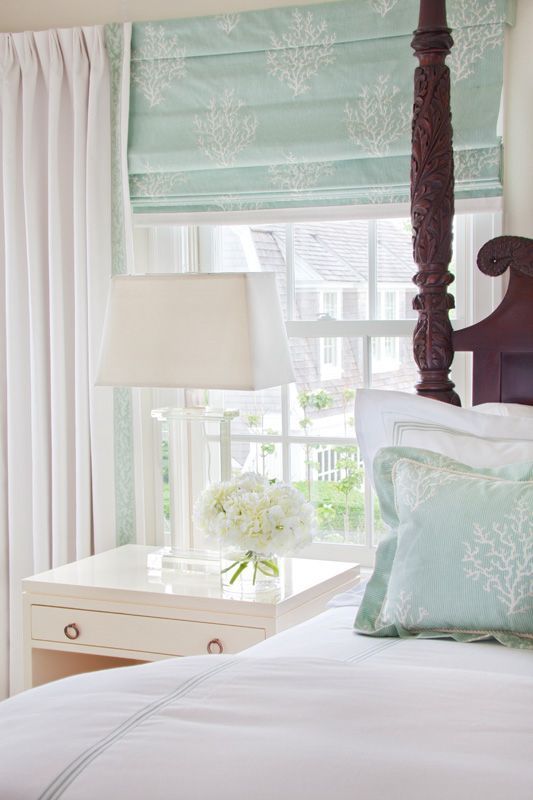
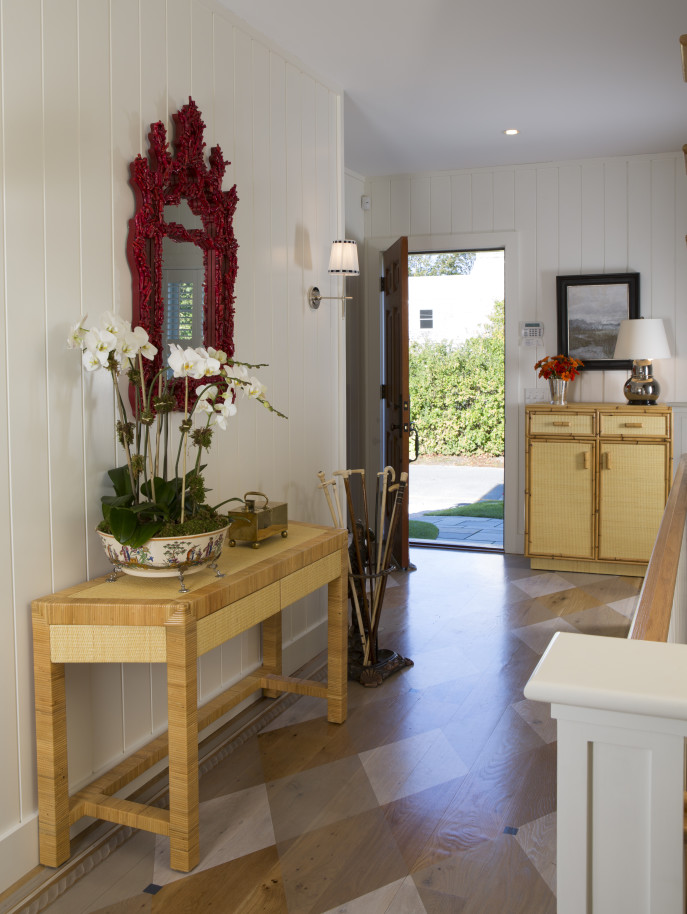
We created interiors with bright splashes of blue and Hermes orange in this six-bedroom, shingle -style cottage for a young family with two teenage daughters.  A short fifteen-minute walk to town, the new home was customized by Dujardin Design Associates from the studs up, including exquisite details such as the wood floor in the entry hall with its hand-painted Harlequin pattern. The rattan-wrapped dresser and table in the foyer are meant to evoke the Breakers in Palm Beach, circa 1950s.

entry hall vertical

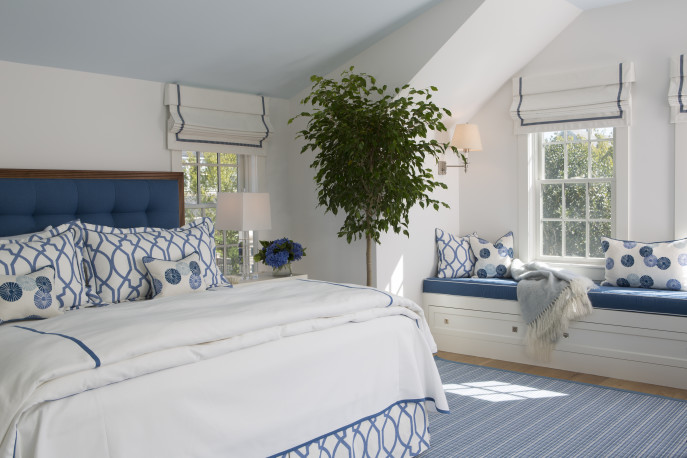
Senior Designer Price Connors created custom built-ins and mahogany topped cabinets for easy storage throughout the home, including hideaway space in the bright and airy bedrooms.

master bedroom

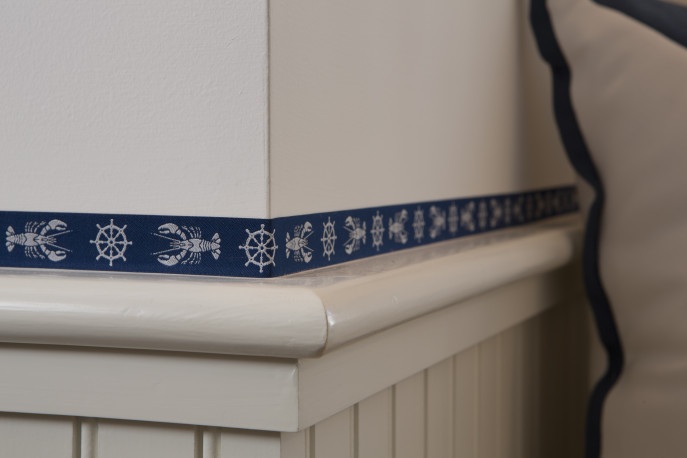
The color palette is crisp and clean, with most walls painted white or ivory with bright white trim. We added interest with pops of color, such as this nautical rope border!

close up navy border

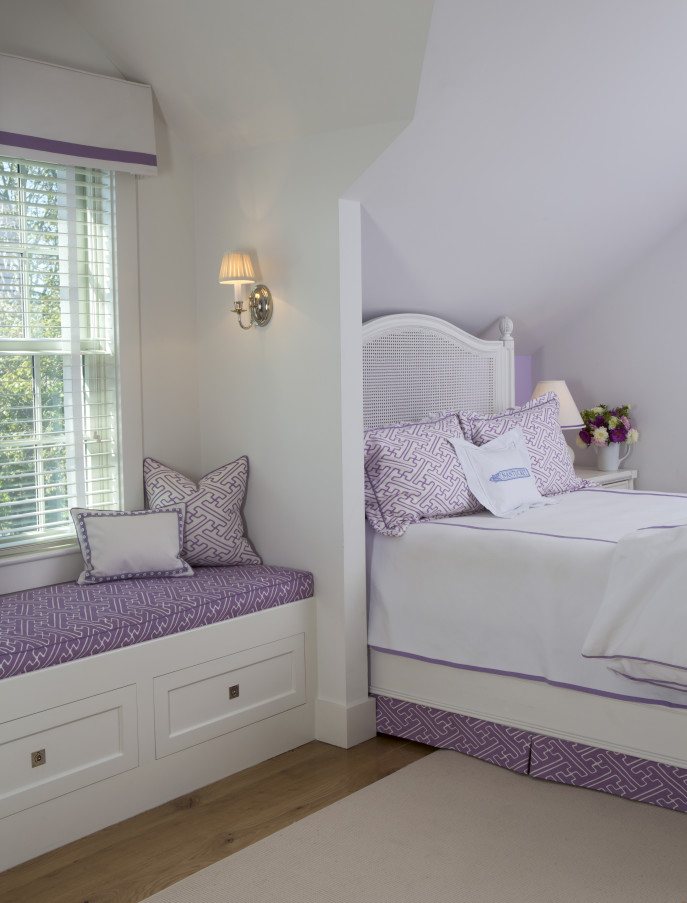
Color continues into all the bedrooms, including this lilac-themed room!

bedroom vertical

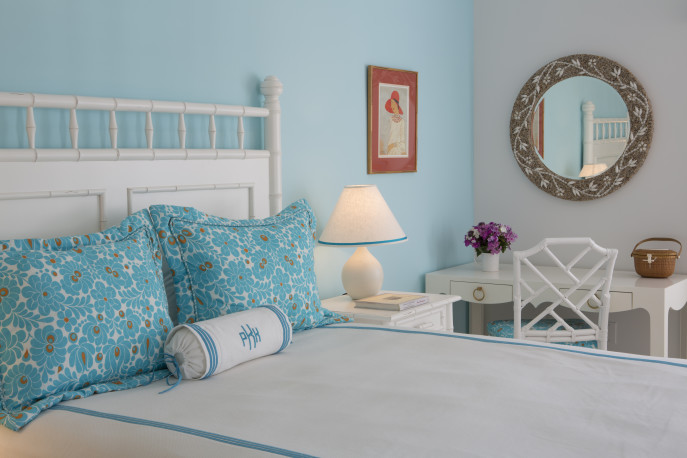
And this blue beauty!

blue bedroomSignature colors were added to the kitchen with stools and bistro chairs handwoven in France.

kitchen vertical

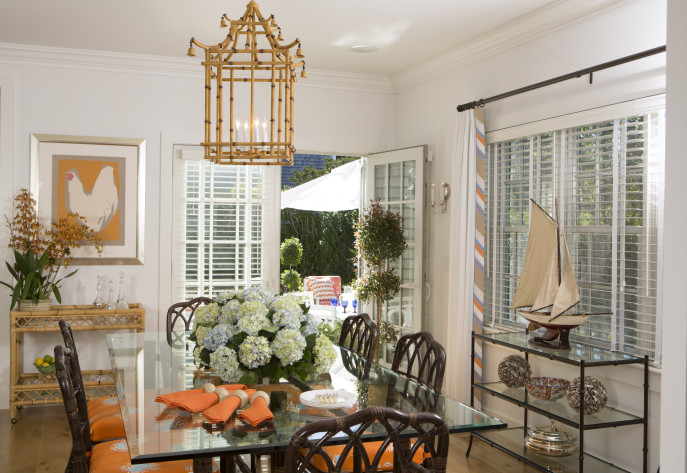
There’s an oriental influence in the dining room, with a pagoda-shaped tole chandelier above the glass dining table.  Gothic backed rattan dining chairs and a rattan bar cart add a classic touch.

dining room

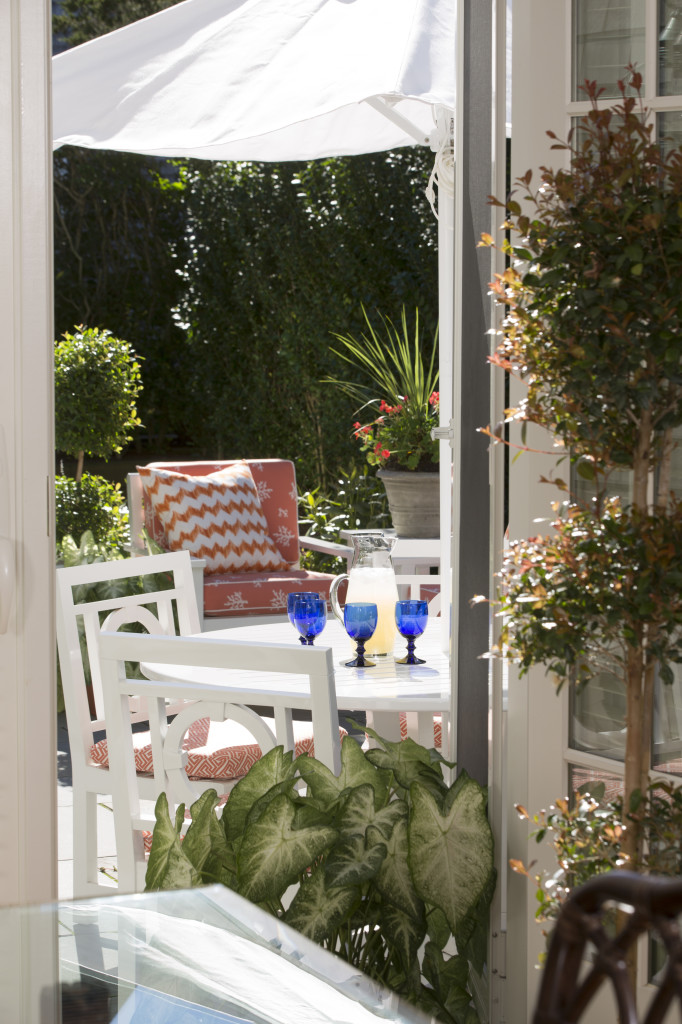
The patio and garden continue the colorful palette, offering another glorious space to enjoy  summer on Nantucket.

patio 2


In the Days of Sailors and Scrimshaw

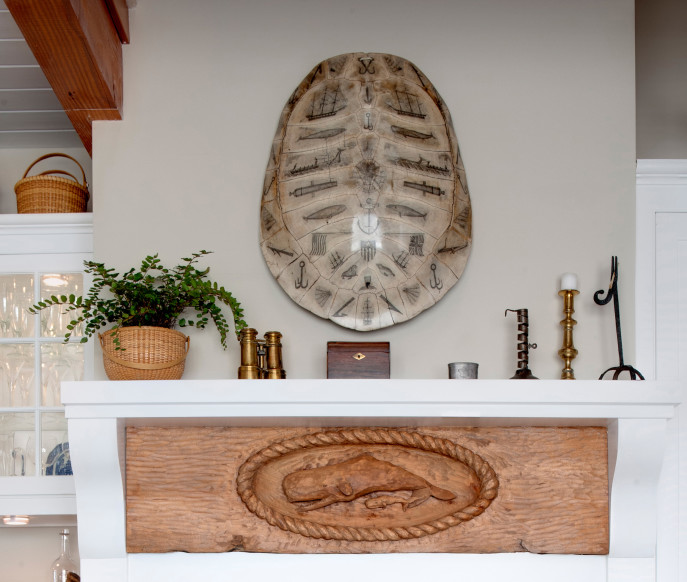
Dujardin_Mantle

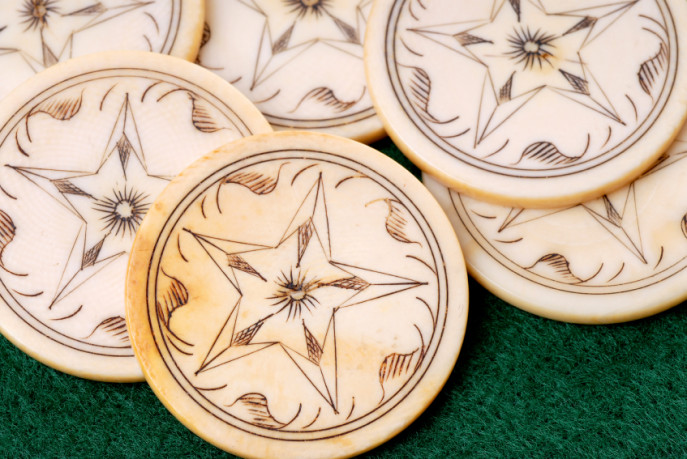
Scrimshaw is the beautiful art form first practiced beginning in 1749, in the days of whaling ships, wizened sea captains and hardy sailors.  Whaling was a dangerous undertaking and could never be attempted at night, leaving sailors with free time on their hands.  They used it for carving elaborate pictures, lettering and scrollwork on the bones and teeth of sperm whales and the tusks of walruses and other marine animals. The work they left behind is a treasured collectible today. The extremely rare white tortoiseshell shown above is an early nineteenth century British scrimshaw, displayed in my home in Madaket.  The whaler’s handwork details ships, whales and equipment used in the seafaring life.


antique scrimshaw poker chips

antique scrimshaw poker chips

John F. Kennedy was an avid scrimshaw collector, and brought it back into fashion when he displayed his 37 piece collection in the oval office in the 1960s.  Today scrimshaw artists (called scrimshanders) can work with eco-friendly or man-made materials, including cow bones, antlers and ostrich eggs.


This 18th Century scrimshaw is carved from a whale tooth.

It’s impossible to write about the beauty of scrimshaw, though, without first acknowledging the damage being done to tusked animals today by poaching.  Where once a ship would set sail with its sights on a whale, and then use every part of the animal for meat, energy and art, there was not an understanding that the seas were a finite resource.

sea turtles

A sea turtle was once plentiful enough that the people of the 18th and 19th centuries could hardly imagine that that creature or any other would be endangered, and in need of protection.  Today, though, we are seeing a rapid decline of animals with tusks and horns, often slaughtered for just those parts of their anatomy and left to decompose.  Although antique scrimshaw is available for purchase and collecting, strict laws are now in place for animal protection. Elephant ivory has been protected since 1976, and is prohibited from being shipped into the United States or practically any other country in the world.


Poaching continues, however. Rhinos are a threatened animal, under siege for their horns, used in Chinese medicine and particularly sought after in Vietnam.  Consumers use ground rhino powder as a health aid, although there is no supporting evidence that it has any impact. Poachers killed 668 rhinos in South Africa in 2012, a 50% increase over the previous year. The World Wildlife Fund estimates another 800 rhinos will die in 2013. To protect them, wildlife managers are injecting the horns of live rhinos with poison and permanent pink dye to make them useless to poachers.  Although the poison is not fatal, it will make anyone who consumes the powdered rhino horn ill with nausea and diarrhea.


Anna Merz, who died on April 4, 2013 in South Africa, started a reserve to protect her beloved black rhinos and became a global leader in the fight against their extinction.   She is shown in the photo above with the rhino she hand-raised as an orphaned baby, Samia.  Samia was devoted to Merz, and followed her everywhere, even trying to enter the house behind her before becoming stuck in the doorway.  When Samia gave birth to babies, she presented them to Merz like any proud mother.

Anti-poaching campaigns are underway worldwide, but more attention is needed to protect the earth’s precious resources.  Learn more about how you can help from The African Conservancy, World Wildlife Fund, or Stop Rhino Poaching.

Gardening with Nature

garden

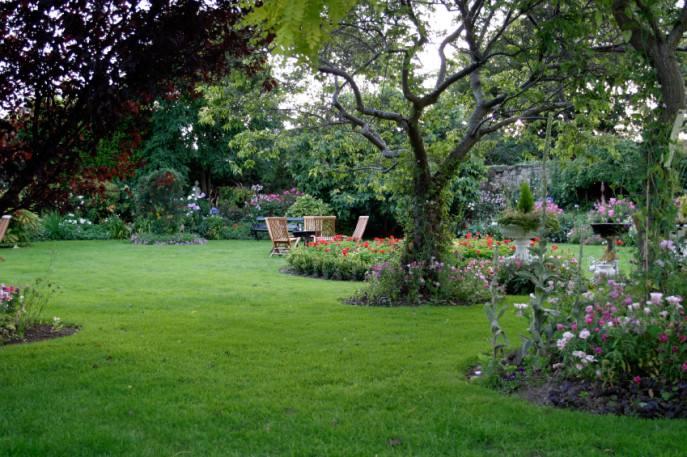
Someone once said that a garden (and lawn, for that matter) has very little to do with nature.  A walk through the woods is proof that wild vegetation is opportunistic and provides only the toughest competitors with space, sunlight and nutrients.  By contrast, we fill our garden with tender annuals and plants that have gone through multiple hybridizations until they bear little resemblance to their original form. Add to that that we prefer our lawns and gardens weed free, carefully edged and mulched, and there’s a sharp divide between a wild meadow and suburban landscaping.


The real difference, however, is our dependence on chemical pesticides, herbicides and fungicides to keep our properties looking as nature never intended.  The best way to create a garden fit for children and pets is to make it a sanctuary for life:  bees buzzing through the flowers, trees brimming with nests and berries, and soft grass that’s safe for bare feet.


Lawn and garden chemicals are poisons to living things.  They pollute our water, harm wildlife and interrupt the delicate balance of our eco-system.  100 million pounds of lawn care chemicals are used by homeowners on their lawns every year.  These include chemicals that kill weeds, insects and a variety of plant diseases.  Many of these chemicals are linked to cancer, birth defects, and liver or kidney damage.  There is a way to have a healthy lawn and garden without resorting to chemicals, however.  Here are three simple steps you can take right away:

  • Healthy soil = healthy plants.  Good soil is alive, teeming with bacteria and organic content that is naturally resistant to pests and disease.  You can boost your soil’s health by spreading organic compost or alfa meal.
  • Use corn gluten as an organic fertilizer.  Organic fertilizers feed your lawn slowly; quick release chemical fertilizers encourage rapid growth that weakens the grass, promotes disease and leaches into nearby surface waters.
  • Tolerate a few weeds.  You can dig them out by hand if they bother you, or you can adopt the philosophy of “live and let live.”  A few weeds in the garden can also provide a home for beneficial insects, which keep the overall landscape in good health.

SONY DSC

Worried about fleas and ticks?  Here are four ways to combat these pests without toxic chemicals:

  • Use Natural Flea and Tick Controls on Your Companion Animals: Look for Buck Mountain Parasite Dust, available only through veterinarians and pet stores.  Its active insecticide is a chemical derived from the Neem tree, which is both a repellant and provides disinfectant and healing properties.  A favorite pet store is Earth Animal, which offers a three step process for natural flea and tick control.  Learn more here.
  • Reduce the tick habitat naturally:  Ticks like moist and shady areas, so let in more sunlight.  If there are many trees, it’s possible to thin their crowns to let more sunlight reach the ground.  Clearing away leaf debris (a favorite tick home) is important, as is cleaning up along stone walls and keeping them free of branches, weeds and other plant debris.
  • Establish a Tick Border: A Tick Border is a three to four foot wide woodchip border that is established between the woody edges of your property and your lawn.  Ticks are loath to cross the sunny, plant free zone.
  • Put up Deer Fencing to stop “tick buses:”  A single deer can be host to more than 200 ticks, so by removing their hosts, you reduce the number of ticks.

Here’s Where to Learn More

Earth

We’re all connected to each other and to every living thing.  The earth is one planet, with air and ocean currents that ignore international boundaries and continents that are impervious to lines drawn on a map.  On a much smaller level, the chemicals you use on your lawn and garden do not stay on your property.  It’s up to each one of us to research and find less-toxic solutions to our pest problems.  You can start here:

  • Integrated Pest Management:  IPM is an environmentally sensitive approach that suppresses pest populations and reduces use of pesticides.  It’s a safer means of controlling pests, with an emphasis on control, not eradication.  IPM holds that wiping out an entire pest population is impossible and environmentally unsafe.  Natural biological processes provide control with minimal environmental impact.  That may mean using beneficial insects that eat target pests, or biological insecticides, derived from nature. The EPA has more information:  read it here.
  • Bio-Integral Resource Center:  BIRC is a nonprofit organization that offers leadership in the development of IPM methods.  BIRC works with homeowners, farmers, cities, park and water districts, schools and pest control professionals in pesticide use reduction.  Visit their website here. 
  • Two books to add to your library:  Common Sense Pest Control, by William Olkowski and Sheila Daar, and Less Toxic Alternatives, by Carolyn Gorman.


Health Begins in the Kitchen

“The cure for what ails us both in our bodies and in our nation can be found in the kitchen. It is a place to rebuild community and connection, strengthen bonds with family and friends, teach life-giving skills to our children, enrich and nourish our bodies and our souls. Yet, in the twenty-first century, our kitchens (and our taste buds) have been hijacked by the food industry. In 1900 only 2 percent of meals were eaten outside of the home; today that number is over 50 percent.”

That quote comes from a brand new book, The Blood Sugar Solution Cookbook, by Mark Hyman, MD.  Dr. Hyman is a family physician, a four time New York Times bestselling author, and is a recognized leader in the field of Functional Medicine:  a way to empower people to stop managing symptoms and instead treat the underlying causes of illness.  He is responsible for coining the phrase “diabesity,” to describe an American population beset by weight gain, diabetes or pre-diabetes.

The right diet is not the same for everyone; for instance, I feel best when I follow a sugar-free, gluten-free, dairy-free diet, as espoused by Dr. Hyman in his new cookbook.  Although the regimen you follow may differ, what is clear is that we must give up on dependence on fat, sugar and salt pumped into factory-made foods.  Dr. Hyman encourages us to take back our kitchens, and our food, and start cooking real meals, made from real ingredients.  His cookbook, just released, offers wonderful recipes to help us do just that.

He tells us:  “We are brainwashed into thinking that cooking real food costs too much, is too hard, and takes too long. Hence, we rely on inexpensive convenience foods. But these aren’t so convenient when we become dependent on hundreds of dollars of medication a month, when we can’t work because we are sick and fat and sluggish, or when we feel so bad we can’t enjoy life anymore.”

Preparing a meal from scratch, by contrast, can be a chance to reconnect with our spouse, children or aged parents.  Sharing that meal can be a ceremony, a ritual, a mindful observance of what matters most in the midst of a hectic life.  That is what a kitchen is designed for, and is its ultimate and most meaningful purpose.

Another book I have found useful on my way to more healthful eating is Forks Over Knives, edited by Gene Stone, which proposes that most, if not all, degenerative diseases can be controlled, or even reversed, by rejecting animal-based and processed foods.  Forks Over Knives:  The Plant-Based Way to Health is a book, a cookbook, and a film available on DVD or Blu-ray.  You can learn more from the website and blog found at www.forksoverknives.com. 

There are other books, other cookbooks and other ways to preserve health, but there has been an overwhelming concensus from the nutrition and diet industry that fruits and vegetables are woefully lacking in our diets, and that increasing the amount we eat is the optimal path back to health.  Choosing organically-grown foods makes sense, as does eating animal protein as a condiment, not an entree, if you choose to retain meat in your diet.
An excellent source of organically-grown vegetables, if you live on Nantucket, is Pumpkin Pond Farm. This  9.5 acre farm and nursery located at 25 Millbrook Road owned by Marty McGowan is Eden-like oasis of color and flavor, offering a wide variety of delicious vegetables and greens.


My passion is helping my clients create beautiful and healthy homes, so I am often called upon to design extraordinary kitchens.  This is the place where nutritious, organic meals are prepared and enjoyed by family and friends, and so it is, truly,  the very heart of the home.

As Michael Pollan, author of The Omnivore’s Dilemma said, “Don’t eat anything your great-grandmother wouldn’t recognize as food.”  That’s good advice.  I intend to follow it.  I hope you do, too.

Basket Case


There is a special kind of beauty in handmade items, particularly those that have stood the test of time.  I have long been a collector of things old and venerable, and love the part I play in keeping and protecting them.  Perhaps it is the rushed nature of time in our lives today that draws so many of us to collectibles such as baskets,  created by people with physically harder days but longer empty hours.


The baskets I love are Nantucket Lightship baskets, crafted by the calloused hands of sailors, sea-toughened men whiling away wet and salt-sprayed hours on a ship that rolled and dipped with the pitch of the ocean beneath it.  The baskets that survive are precious now, perhaps all the more so because once they were not.

When they were new, they held bread and sewing and berries gathered from the hedge beside the cottage.  They were made by men who worked hard with their hands, and used by people who did the same.

Today, Lightship Baskets are a collectible treasure so valued on Nantucket Island that they have a museum dedicated to them. Located at 49 Union Street, the Nantucket Lightship Basket Museum is dedicated to the island’s rich history of basket making, as well as a nod to the history of the Lightships.

In the 19th Century, Lightships were sentinels stationed at dangerous off-shore shoals, warning others in the waters of treacherous shipwreck sites.  The first lightship was stationed at Nantucket’s South Shoal on June 15th, 1854.

Whale oil supplied the warning lamps in early years, seen at most at a distance of a few miles on a clear night, far less when the weather turned grey and stormy. Nantucket Lightship crewmen were basket makers for diversion from boredom, as well as a way to earn extra income.

It was after 1900 that work on the the baskets moved off ships and onto the island.  In the late 1940s, Jose Formoso Reyes, one of the foremost basket makers of his time, created the “Friendship Basket,” a cane woven basket with a lid and a carved ivory whale mounted on top.  It is the model for the popular handbags sold today.

In my many years as a Nantucket Islander, I have frequently found myself unable to resist these treasured baskets.  My collection was written about in a blog post that you can read at Connecticut Cottages & Gardens.

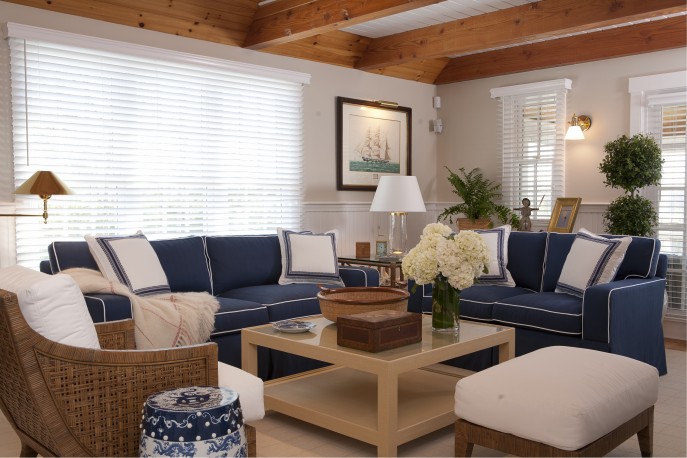
My Madaket living room; Lightship basket on table.  Photo courtesy of Terry Pommett

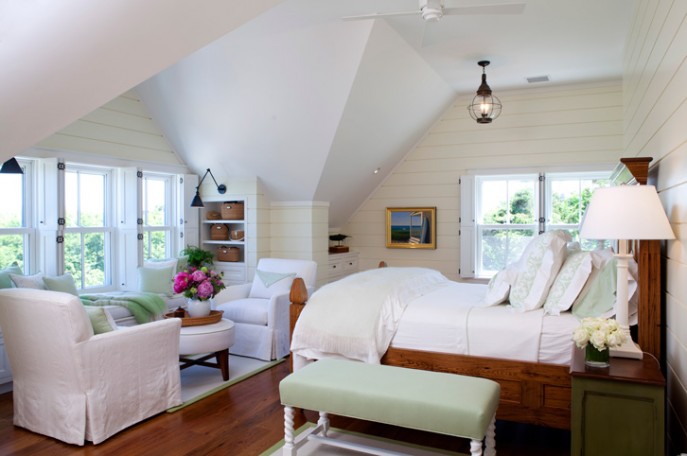
My kitchen in Connecticut, Lightship basket on island; photo courtesy of Durstan Saylor

Perhaps this post will inspire you to start a basket collection of your own, or to find the space to display with grace and reverence the ones you already own.  We are so blessed to live in a world where such treasures can be found.


Lightship basket collection displayed on built in shelves; photo courtesy of Terry Pommett


The World as Jinsey Dauk Sees It

Part Two in an Occasional Series on My Favorite Artists


If you’ve ever wondered what a bee sees when he’s buried deep within the folds of a flower, surrounded by color and bemused by fragrance, then you shouldn’t miss the fine art photography of Jinsey Dauk.   An artist with an eye for the smallest of sensuous details, Jinsey uses a camera to capture what’s most miraculous about life.  Then she presents her vision to all of us who are hurrying past a frisson of flowers or a riot of raindrops without really seeing them at all.

Jinsey’s love for photography began early. As a very young girl, when a friend of her mother’s became ill with leukemia, she picked up a Minolta camera for the first time to take pictures of the woman’s son.  An innate talent for seeing the world in striking detail was quickly apparent.  Jinsey captured the boy leaping with a basketball in his hands, sunlight in his eyes, and his mother posted the photos around her hospital room.  Soon visitors and friends were asking who took the photos, and her career began, first by taking black and white portraits of children for whom she babysat.

Fast forward a couple of decades.  Jinsey spent time working as a Ford and Elite model, then launched a career as a documentary-style wedding and portrait photographer, primarily in black and white, before turning her camera toward the beauty of nature in full, glorious color.

Once again, serendipity intervened in her life.  She began simply, by photographing flower arrangements on the sunlit windowsills of her Tribeca apartment to thank the friends who had sent them; before long, those friends were insisting she create large-scale art pieces and offer them for sale.  From that point, she branched out into shooting more than flowers, and she quickly gained a following.

Today, Jinsey’s work is available as metallic prints, without frames, pressed under a quarter inch of plexiglass.  Although many collectors prefer the large version, and collect them as diptychs, triptychs or quadtychs, (sometimes even as a series of six), Jinsey happily custom-sizes her pieces to fit a particular space in home, office or boutique hotels. She is also happy to work on commissioned pieces and will travel to photograph whatever a client chooses, whether it’s a beloved rose garden or another cherished item.

Using macro lenses and micro filters from the 1960’s and blending those techniques with today’s sophisticated digital photography is how she creates her work, but it doesn’t begin to explain her vision.  She describes her first foray into photographing flowers as a journey she undertook, albeit one with camera in hand.

“I traveled through those flowers and ferns and bouquets, traveled through a whole different universe.  Each turn of my focusing ring was escaping into another world,” she says.  “Photography changes me.  It’s a private experience.  I’m six foot one, but in this world I’m all scrunched down, into something the size of a thumbnail.  Every single one of my senses gets touched upon when I photograph something. I hope that viewers of my work will have the same experience.”

Jinsey grew up in Rowayton and Darien, Connecticut.  Her mother still lives in Darien,  in a matriarchal home owned first by her mother’s grandmother, then her mother’s mother, and now it belongs to her mother.  Jinsey’s photographs hang in rooms that overlook Long Island Sound, next to traditional, older oil paintings that have been in the family home since the turn of the last century.

“My art mixes so well with those old paintings,” Jinsey explains. Perhaps it’s the constantly shifting colors of the ocean outside the windows, or the way the light falls on the nature-infused colors of Jinsey’s work, but her photographs transcend a single definition.  She’s proud to see her work hang in offices and homes with many different styles.

Erika Del Priore, of Erika Del Priore Interiors, describes her work like this:  ” The colors, while bright, recede into the photo – pulling us in. Once in, colors and shadows reveal small nooks and passages that take us … I don’t know where, but it is warm and calm.”

Warm is the way to describe Jinsey, too.  She’s enthusiastic, outgoing and the kind of person you feel like you’ve known forever.  When renowned photojournalist Andre Kertesz said that “you don’t see things you photograph, you feel them,” he could have been talking about Jinsey. Jinsey says she is inspired by his work, as well as the black and white photographs of Henri Cartier-Bresson, Robert Doisneau and George Brassai; her color inspiration comes from Georgia O’Keeffe, Paul Gaugin, Henri Rousseau, and images from her own work.

Whoever’s work inspirits and inspires Jinsey, she’s always an artist who sees things her own way. Jinsey creates her pieces to embody the feeling of flow and fluidity, which is why she presents her work not only as individual pieces, but as a series.  According to a friend and client, her pieces create connections through “color, form, light, eyes and smiles.”  It’s the world as Jinsey sees it, and we’re lucky to share the view.

To contact Jinsey Dauk Fine Art Photography, call 212-243-0652, email Jinsey at info@JinseyArt.com, or visit her website at www.JinseyArt.com. An installation of 21 metallic fine art prints with rotating images is available for viewing in a beautiful Tribeca office space.  Call to schedule an appointment.  Scroll down for more of Jinsey’s work.


Celebrating the Twinkling Season


I love the holidays, and one of my favorite tasks of the year is creating festive interiors for my clients.  This is truly the twinkling season, and time for making magic in every room of the house.  In this home, featured in this month’s ONLY Nantucket Magazine, we used fresh greens for garlands and wreaths, dressed seven full-sized, themed trees matched to each room’s decor, and embellished with mistletoe and holly, little white lights and gauzy bows!

Come along with me and take a look at the little details that add up to a lot of holiday cheer.  I hope you’ll be inspired to create your own unforgettable winter charm!

A grand display of red roses in a clear crystal box is always eye-catching and elegant, especially when combined with candlelight.

Formal columns have become whimsical candy canes, white hydrangeas grace the cocktail table from John Boone, boxwood tucked into antique garden urns make a festive hearth.

A Christmas tree bedecked in gold and silver gleams in the corner of the music room.  Wreaths tied with gauzy pale green ribbon adorn each and every window, and exotic white and green fringed Parrot Tulips, unusual for Christmas, strike just the right note in the elegant gathering space.  The Rose Tarlowe ottoman is perfectly placed for guests to sit and enjoy a sing-along, underneath a chandelier graced with evergreens.

A rock crystal chandelier sparkles above a table with the spirit of the homeowners’ beloved Nantucket:  white hydrangeas and red winter branches are a celebration of the island’s simple beauty.  The mantle is gloriously layered with evergreens, ribbons and stars; a stocking hangs by the hearth, waiting for St. Nicholas.

The kitchen has another candy cane column for a punch of gaiety; glass hurricanes on the counter are filled with little crab and lady apples.  A five-tiered gift box cake is waiting for guests to arrive:  there’s a party planned this evening!

The stairwell leading to the master bedroom suite is a feast for the senses:  fragrant cedar, spruce and boxwood swags are wrapped in ribbons; a single silver ball dangles from the sumptuous crystal chandelier custom-designed by Dujardin Design Associates.

A delicious tray of holiday confections add the sweetness of sugar and spice to the homeowners’ celebration: this couple blends their backgrounds and heritage in style, embracing both Christmas and Hannukah.

Whatever holiday you embrace, make it your own season of abundance and grace!  And remember to make it merry.  If you’re on Nantucket, look for the December issue of ONLY Nantucket for more of this holiday home!


Autumn in Connecticut

photo courtesy of Michael Passarello

 Dear Readers,

This post was written before the devastation of Hurricane Sandy across the northeast.  The beauty of fall is one side of the story; storms and dangerous weather are also part of life in Connecticut, and throughout the world.  I invite you to join me in a look at the gentler side of Autumn, even as we keep those still without power or homes in our thoughts.  I’m making a donation to the Red Cross today.  I encourage you to do whatever you can to help restore our communities.

Autumn is such a beautiful season.  My friend Michael Passarello sent me some wonderful pictures he’s taken, and it inspired me to share the beauty of Connecticut with all of you. Come join me on a virtual walk through the countryside I love, and let’s enjoy the beauty of a Fall day together!


japanese maple leaves; photo courtesy of Michael Passarello
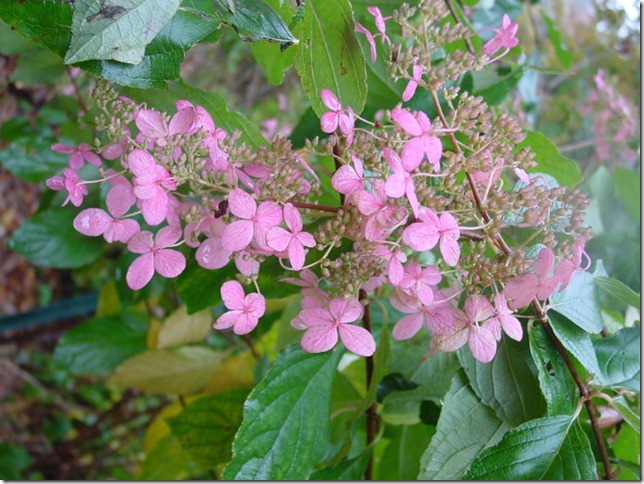
“Autumn is a second spring, where every leaf is a flower.”  –Albert Camus

autumn hydrangea; photo courtesy of Michael Passarello

“Autumn, the year’s last, loveliest smile.”–William Cullen Bryant

stewarthia; photo courtesy of Michael Passarello
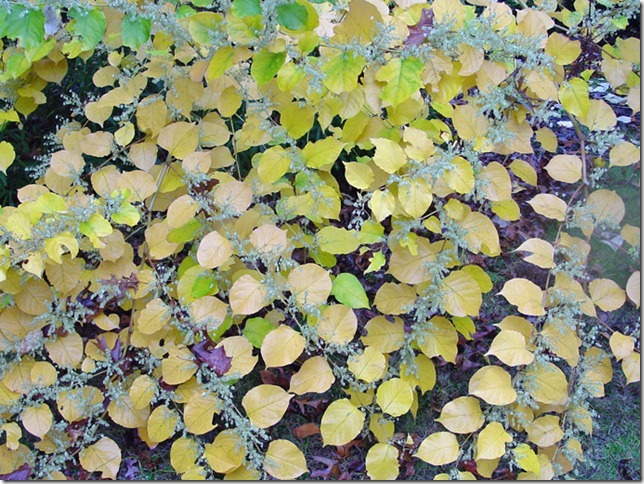
“Autumn burned brightly, a running flame through the mountains, a torch flung to the trees.”  –Faith Baldwin

photo courtesy of Michael Passarello

“Autumn is the mellower season, and what we lose in flowers, we more than gain in fruits.”–Samuel Butler

photo courtesy of Michael Passarello

“The morns are meeker than they were, the nuts are getting brown; the berry’s cheek is plumper, the rose is out of town.  The maple wears a gayer scarf, the field a scarlet gown.  Lest I should be old-fashioned, I’ll put a trinket on.” –Emily Dickinsen

“Delicious autumn!  My very soul is wedded to it, and if I were a bird I would fly about the earth seeking the successive autumns.”–George Eliot

You can’t celebrate autumn without enjoying its wonderful foods.  My husband, Frank, makes a delicious pumpkin tart:  it’s gluten free, sugar free and lactose-free!

  Here’s the recipe.  We call it:

Frank’s Amazing Gluten-free, Lactose-free, Sugar-free Pumpkin Tart

(that makes its own crust!)

Do it all right in the blender!

First of all, all ingredients must be organic.  No pie crust needed – it makes its own thin crust – more like a souffle.

Place in blender:

  • 1 can 16 oz. organic pumpkin
  • 1 can or 13oz. either organic unsweetened evaporated milk or organic Rice Milk or Almond Milk (Amasake) – each one gives a different consistency
  • 2 organic eggs
  • 2 teaspoons organic vanilla extract
  • 2 teaspoons organic pumpkin pie s pice mix (or to taste)
  • 1/4 cup sugar OR 2 teaspoons local organic honey –which we prefer (or to taste)
  • 1/2 cup of organic rice flour

Heat oven to 350 degrees

Lightly butter a pie plate. (We use Earth Balance–an organic buttery spread that’s gluten-free, vegan, lactose-free, expeller-pressed oil)

Put all the above ingredients –except rice flour– in a blender.  Blend until smooth.  Gradually add 1/2 cup of organic rice flour to the blender mix until absorbed – can add more if consistency is too thin.  Pour into pie plate.  Bake until golden brown and knife inserted in center comes out clean, about 50 – 55 minutes.  Refrigerate any remaining pie.

Enjoy!


Photo credit:  Michael Passarello is a writer, photographer, greenhouse consultant and all around nice guy, living in the woods in North Stamford in Hedy Lamar’s old house.  You can reach Michael to inquire about his photographs at zylvert@gmail.com.

Thank you, Michael!


The Sea-Worthy Artwork of Michael Keane

Update to this post: Michael F. Keane, Jr. died unexpectedly on March 28, 2015. The following tribute comes from Quidley & Company Fine Art, a gallery that had been home to the artist and his artwork for many years.

“For the past three decades, Michael brought joy to those who viewed his artwork. His serene and luminous marine paintings portrayed the warmth of summer days spent sailing on Nantucket Sound. Keane had the remarkable ability to transport a viewer: to gaze at one of Michael’s beautiful and obviously lovingly wrought images is to imagine yourself cruising on the open sea–whether on a striped sail Beetle Cat or a majestic J-Class yacht–it’s the next best thing to actually being out there.” 

I hope you enjoy a look at some of Michael’s lovely, peaceful work. His contribution to the art world will never be forgotten. 

Rainbow Run

Part One in an Occasional Series on My Favorite Artists

I love the play of light on sand and sea on Nantucket Island.  It inspires artists here just as the light in the South of France has inspired so many of my favorite artists for centuries; the sunlight shimmers and sparkles in a way that is magical to observe, and I am in awe of those talented painters who can capture it on canvas.

Off Boston Harbor

One of those painters is famed marine artist Michael Keane.  A dear friend for years, and a fine arts painter for over half a century, Michael’s work is eagerly sought after by collectors.  His shows are an established tradition here on Nantucket, where people who love to sail and love the sea appreciate the special affinity he has for painting the world of waves and wind.

The Mighty Twelves

Truly a Renaissance man with so many interests and skills I can’t keep track of them all, Michael’s career as a painter was never pre-ordained.  When it was time for college, although he had painted since childhood, his father insisted he attend a teacher’s college instead of art school, hoping to see his son gainfully employed.  But Michael hated it, and he worked instead at a number of mundane and laborious jobs, including time spent in factories, as an auto mechanic and at a shipyard.

Determined to be an artist, though, he served an eight year apprenticeship with noted landscape painter, Edward Harrigan, and a four year apprenticeship with noted marine artist Marshall W. Joyce.  After that, he studied for four years, and then taught portraiture and figure painting with Clemente Micarelli in his studio.  He majored in Visual Design at UMass and afterward taught painting for 17 years.

Blue Horizon

His break into the art world came with a Best in Show award at a Duxbury, Massachusetts art show.  The painting entered there began a new life for Michael, at a time when he desperately needed it.  In poor health from a rheumatic illness, he was unable to summon the strength to continue his physically demanding day job.

He went to his favorite place on Duxbury Beach, and as he describes it, “Everything was going all wrong.  As I stood there, the sky turned black, and it started to hail and rain.  As I looked across the sea, all of a sudden the light broke through.  It raced across the land in a splash of color.  I knew this was a transcendent moment; I felt I was being told to ‘paint this.’”

The Squall at Gurnet Head

He did quick color notes, which became the inspiration for his painting The Squall at Gurnet Head.  After that, things turned sharply around. Everything he painted flew off the wall.  “It was providential,” he says.  “It all happened when things couldn’t get any lower; it felt like a dream.  Things happened the way they needed to happen, when they needed to happen.”

A Twilight Sail

In explaining his creative process, Michael says he loses all sense of time and space when he works.  “I once did a big painting in less than a week—I felt like I didn’t paint it.  I held the brush, and the brush just went.  As an artist, I’m wide open to what I’m receiving.  It’s a sensitive thing.”

Off Nantucket

People have always been drawn to his work, and although he doesn’t understand all the reasons, he thinks it may be related to the reason that he paints.  “Art should elevate life,” he says.  “That’s the whole point of it.  Fine art should express higher ideals.  We get enough in life to pull us down, art should lift us up.

“Like good music, art lifts you, it changes you, it alters your state of consciousness,” he continues.  “That’s what exhilaration is.”

The Last Trap

Everyone who knows Michael, who loves his work, and who buys his paintings, tells him the same thing.  “They tell me they look at the sky now—they say, ‘you made me look at the sky.’”

I can’t imagine a higher elevation for art, or an artist, than that.

“There is one spectacle grander than the sea, that is the sky.” –Victor Hugo

You can find Michael Keane’s artwork at Quidley and Co. Galleries in Boston and Nantucket, Massachusetts, and at Russell Jinishian Galleries in Fairfield, Connecticut.