
The Sea-Worthy Artwork of Michael Keane

Update to this post: Michael F. Keane, Jr. died unexpectedly on March 28, 2015. The following tribute comes from Quidley & Company Fine Art, a gallery that had been home to the artist and his artwork for many years.

“For the past three decades, Michael brought joy to those who viewed his artwork. His serene and luminous marine paintings portrayed the warmth of summer days spent sailing on Nantucket Sound. Keane had the remarkable ability to transport a viewer: to gaze at one of Michael’s beautiful and obviously lovingly wrought images is to imagine yourself cruising on the open sea–whether on a striped sail Beetle Cat or a majestic J-Class yacht–it’s the next best thing to actually being out there.” 

I hope you enjoy a look at some of Michael’s lovely, peaceful work. His contribution to the art world will never be forgotten. 
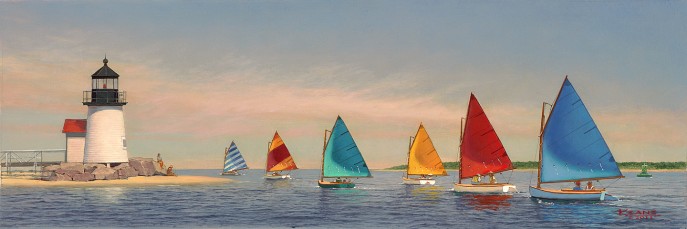
Rainbow Run

Part One in an Occasional Series on My Favorite Artists

I love the play of light on sand and sea on Nantucket Island.  It inspires artists here just as the light in the South of France has inspired so many of my favorite artists for centuries; the sunlight shimmers and sparkles in a way that is magical to observe, and I am in awe of those talented painters who can capture it on canvas.
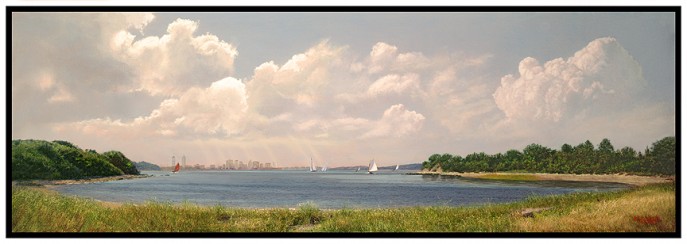
Off Boston Harbor

One of those painters is famed marine artist Michael Keane.  A dear friend for years, and a fine arts painter for over half a century, Michael’s work is eagerly sought after by collectors.  His shows are an established tradition here on Nantucket, where people who love to sail and love the sea appreciate the special affinity he has for painting the world of waves and wind.
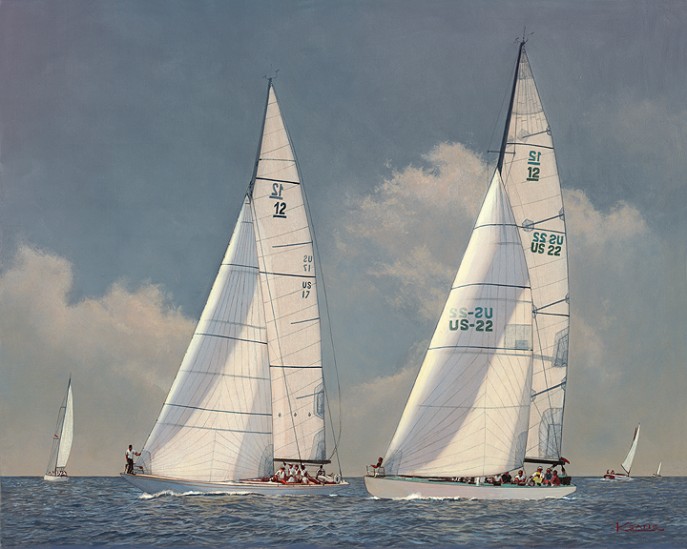
The Mighty Twelves

Truly a Renaissance man with so many interests and skills I can’t keep track of them all, Michael’s career as a painter was never pre-ordained.  When it was time for college, although he had painted since childhood, his father insisted he attend a teacher’s college instead of art school, hoping to see his son gainfully employed.  But Michael hated it, and he worked instead at a number of mundane and laborious jobs, including time spent in factories, as an auto mechanic and at a shipyard.

Determined to be an artist, though, he served an eight year apprenticeship with noted landscape painter, Edward Harrigan, and a four year apprenticeship with noted marine artist Marshall W. Joyce.  After that, he studied for four years, and then taught portraiture and figure painting with Clemente Micarelli in his studio.  He majored in Visual Design at UMass and afterward taught painting for 17 years.
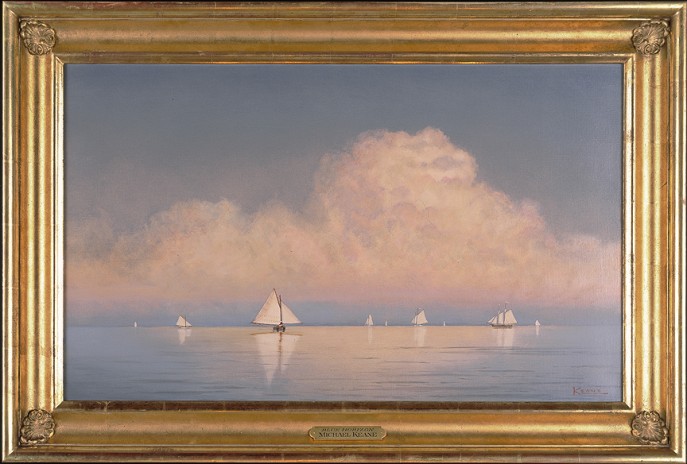
Blue Horizon

His break into the art world came with a Best in Show award at a Duxbury, Massachusetts art show.  The painting entered there began a new life for Michael, at a time when he desperately needed it.  In poor health from a rheumatic illness, he was unable to summon the strength to continue his physically demanding day job.

He went to his favorite place on Duxbury Beach, and as he describes it, “Everything was going all wrong.  As I stood there, the sky turned black, and it started to hail and rain.  As I looked across the sea, all of a sudden the light broke through.  It raced across the land in a splash of color.  I knew this was a transcendent moment; I felt I was being told to ‘paint this.’”
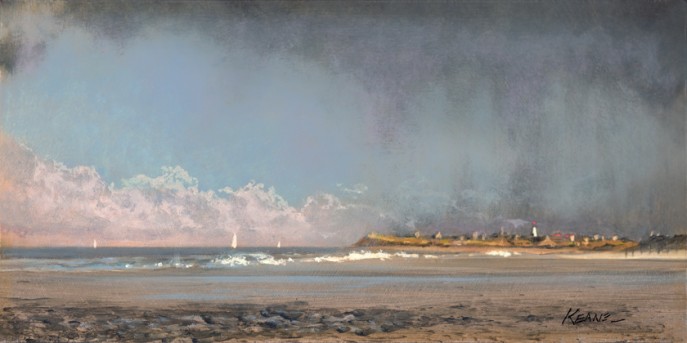
The Squall at Gurnet Head

He did quick color notes, which became the inspiration for his painting The Squall at Gurnet Head.  After that, things turned sharply around. Everything he painted flew off the wall.  “It was providential,” he says.  “It all happened when things couldn’t get any lower; it felt like a dream.  Things happened the way they needed to happen, when they needed to happen.”
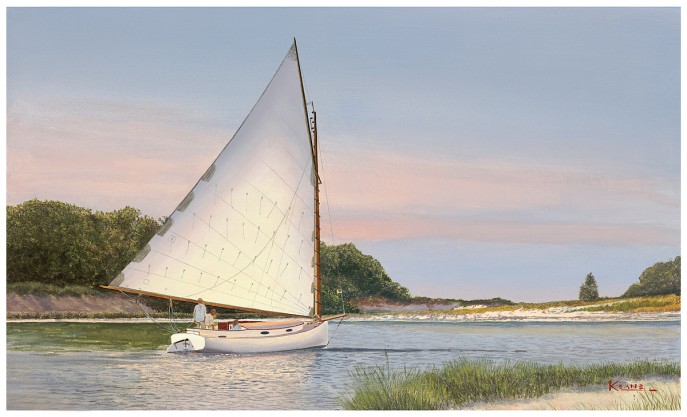
A Twilight Sail

In explaining his creative process, Michael says he loses all sense of time and space when he works.  “I once did a big painting in less than a week—I felt like I didn’t paint it.  I held the brush, and the brush just went.  As an artist, I’m wide open to what I’m receiving.  It’s a sensitive thing.”
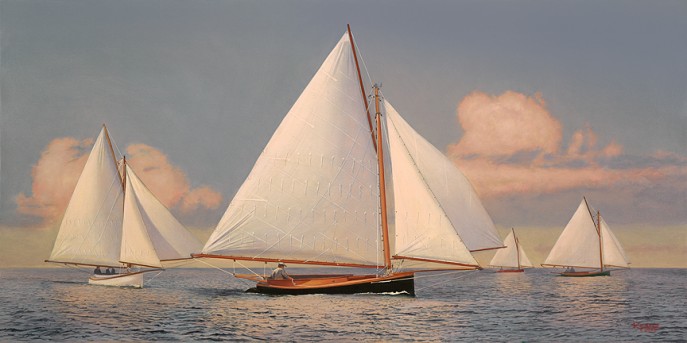
Off Nantucket

People have always been drawn to his work, and although he doesn’t understand all the reasons, he thinks it may be related to the reason that he paints.  “Art should elevate life,” he says.  “That’s the whole point of it.  Fine art should express higher ideals.  We get enough in life to pull us down, art should lift us up.

“Like good music, art lifts you, it changes you, it alters your state of consciousness,” he continues.  “That’s what exhilaration is.”
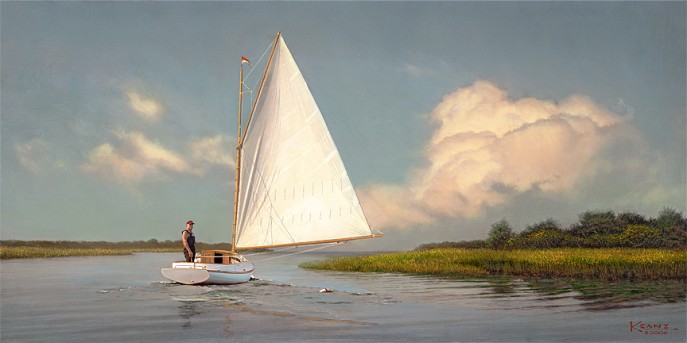
The Last Trap

Everyone who knows Michael, who loves his work, and who buys his paintings, tells him the same thing.  “They tell me they look at the sky now—they say, ‘you made me look at the sky.’”

I can’t imagine a higher elevation for art, or an artist, than that.

“There is one spectacle grander than the sea, that is the sky.” –Victor Hugo
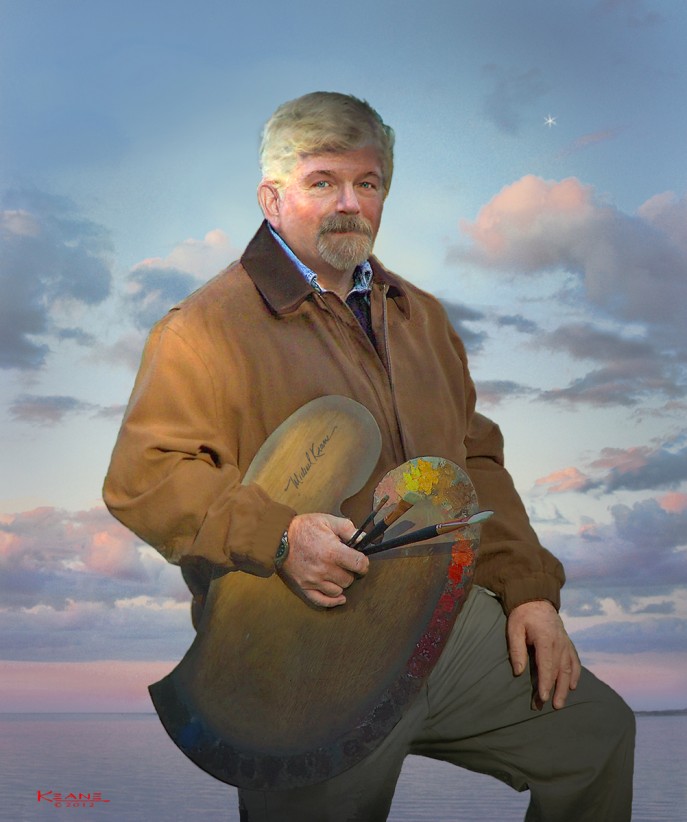
You can find Michael Keane’s artwork at Quidley and Co. Galleries in Boston and Nantucket, Massachusetts, and at Russell Jinishian Galleries in Fairfield, Connecticut.


“I Send Thee a Shell from the Ocean-Beach”

Clients often ask me where I get my inspiration for the colors and textures for the rooms I design.  The world outside my door is a constant source of inspiration, especially the sea. (Read an earlier post on my color inspiration here.) I also love to read, and my library is full of beautifully illustrated books that fill my hands and my heart when I can’t be on my beloved Nantucket.

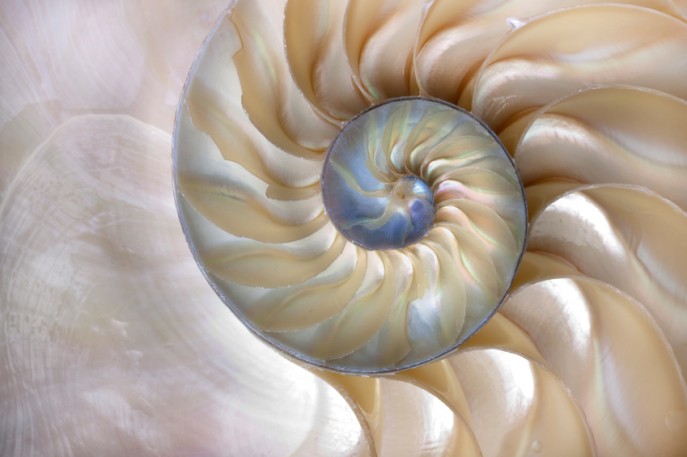
It’s no secret that I have always loved seashells; the logo for my company is a Nautilus shell, a beautiful example of what is called a golden spiral (also known as a logarithmic spiral).   Choosing the Nautilus shell was not accidental:  it perfectly represents a profession where proportion and balance are key to achieving a pleasing design.  We may not need to understand the science behind a masterfully (and mathematically) balanced design, but we are naturally drawn to elegant and balanced compositions, repeatedly found in nature.

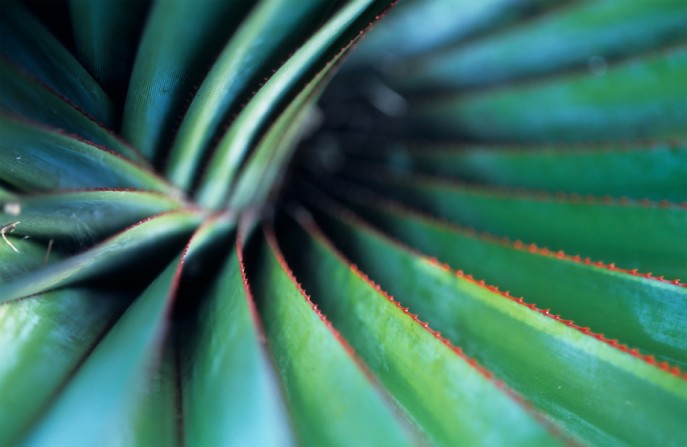
This is a close-up photograph of a spiral palm leaf.
The concept of what makes the proportions of the chambers of a Nautilus shell so beautiful is explained by something called The Fibronacci series, often referred to as nature’s numbering system.  It is displayed to perfect effect in the bracts of a pinecone, the heart of a sunflower, the scales of a pineapple, a grain of wheat, a hive of bees, the spiral palm, and even in the proportions of the human body. Leonardo Da Vinci portrayed this concept with his sketch of Vitruvian Man.


Many architects and artists have proportioned their work according to geometric principles known as the golden rectangle, the golden mean and the golden ratio, aesthetically pleasing proportions found over and over again in nature, in stems of plants and veins in leaves, and of course, in seashells such as the Nautilus.

In a golden rectangle, the smaller rectangle is the same shape as the larger rectangle, in other words, their sides are proportional. The curved design of the chambered nautilus shell and the ratios between each of the spirals reveal the fascinating connection between nature, geometry and architecture.  Read more here.

Each single shell represents the world of nature’s intricate and mysterious designs, and is a work of art in itself. It is no wonder their shapes are frequently mirrored in our homes and lasting pieces of architecture.

I frequently place shells where they can be seen and admired, especially in beachside homes. In case you’re looking for a little inspiration yourself, here are two seashell books you might find on my coffee table if you were to visit:


The World’s Most Beautiful Seashells won the Coffee Table Book Award of the National Association of Independent Publishers for 1996. Filled with stunning pictures by photographer James H. (Pete) Carmichael, who is especially well-known for his work with shells, butterflies, and rainforests, the wonderfully-written text is by Leonard Hill, a lifetime shell enthusiast, and a biologist employed by the US government who monitors the health of the oceans.


If you’ve ever come home from the beach with a pocket full of seashells, then this book was written just for you! Written by Marlene Hurley Marshall,  it’s filled with inspiring ideas of all the wonderful things you can do with your beachy treasures. Frames, chandeliers,  boxes, mirrors:  they can all be enhanced with memories of your time spent seaside.


“I send thee a shell from the ocean-beach;
But listen thou well, for my shell hath speech.
Hold to thine ear
And plain thou’lt hear
Tales of ships.”

Source, Listening to seashells
Charles Henry Webb, With a Nantucket Shell, reported in Bartlett’s Familiar Quotations, 10th ed. (1919).

Guest Post: Adrienne Sprouse, MD, Talks about ADD

From Trudy:  “I’m delighted to have the opportunity to share the thoughts of Dr. Adrienne Sprouse as a guest blogger.  Dr. Sprouse has dedicated herself to the field that saved her life:  Environmental Medicine.  After being diagnosed with Chemical Sensitivity and successfully treated, she was accepted to eleven medical schools at the age of 37, and chose Columbia College of Physicians and Surgeons, graduating with multiple awards.

In 1995, she opened New York City’s first chemical-free environmental medicine center, treating patients made ill from environmental factors.  She has appeared on ABC News, NBC News, New York One and The Tony Brown Show, as well as serving as the Environmental Specialist for Fox Good Day New York. She has been an important part of my own journey to good health.”

A.D.D.:  Psychiatric Illness or Medical Problem in Disguise?

Children and adults who suffer from Attention Deficit Disorder usually have one or more of these symptoms: inattention,hyperactivity, poor impulse control, poor school performance, social impairment, and low motivation.  However, these troublesome symptoms can also be caused by several medical problems.

Medical Illnesses Mimicking ADD

Several medical conditions cause symptoms similar to ADD.  These medical conditions include:

  • nutritional deficiencies
  • food allergies
  • inhalant allergies
  • sensitivities to chemicals
  • heavy metal exposure
  • hormonal imbalances
  • medication reactions
  • seizures, etc.


If You Are Having Behavioral Problems, Please Consider the Following:

Do you have a nutritional abnormality?

The body needs certain vitamins, minerals, fatty acids,carbohydrates, and amino acids to work correctly.  If one or more of these vital nutrients is low or abnormally elevated, behavior changes can follow.  It is possible to measure your body’s levels for these important nutrients and then tailor a nutritional program to your specific needs.

Do you have a hormonal abnormality?

Thyroid, adrenal, and sex hormones play key roles in body metabolism.  An abnormality in any of these hormones can cause inattentiveness and a depleted mood.  Many chemicals in the environment today are hormone disruptors and can alter the performance of hormones in your body.  A thorough hormonal assessment can identify abnormalities and a corrective plan can be designed.

Do you have food allergies?

Symptoms of food allergy include irritability, itchy eyes, abdominal bloating, headache, sleepiness after a meal, bed wetting, recurrent ear infections (esp. in children) sinus infections, and behavior changes.  Treating food allergies can bring significant relief.

Do you have inhalant allergies?

The following inhalants have been documented to cause illness:  molds, pollen, trees, grasses, flowers, dust, cats, dog, and cockroach.  Identifying and treating your inhalant allergies can go a long way toward returning you to good health.

Do chemical exposures make you sick?

Toxic chemicals abound in our environment and often go unsuspected as a cause of illness.  Any one (or more) of the following chemicals or items can make you ill:  your gas stove, commercial cleaning products, air fresheners, new carpeting, perfumes, paint and varnish, personal care products, new computers, cigarette smoke, copier fumes, pesticides, etc.

Where Chemicals Are Stored

After chemicals enter our bodies, they circulate through the bloodstream to all parts of our bodies…even our brains.  In fact, many of these chemicals are fat soluble and get stored in the body’s fat.  After chemicals enter your body, they will find that fat which then will serve as a reservoir for dangerous toxins and become a staging ground for toxic illness.  Only proper diagnosis followed by individualized treatments to remove those substances will reduce your chemical load.

Clearing Chemicals From the Body

Chemicals already in the body are not likely to leave on their own.  So if you can, avoid them.  But if you can’t or didn’t, you have to remove them.   To remove them, we’ve got to assist the one organ in our body that is the command center for clearing and fighting our war against toxic chemicals:  the liver.  Through a process called detoxification, your chemical load can be reduced.

Phase I liver detoxification results in the modification of reactive  chemicals  by a series of chemical reactions like oxidation, reduction, etc.  Big words, but let it go as the first internal “scrub down.”

Phase II liver detoxification may follow Phase I reactions or may proceed independently.   Here, the liver maximally converts fat-soluble substances to water-soluble substances, facilitating their excretion from the body.  Look at Phase II as the “flush.”

To accelerate the detoxification process, a combination of selected nutrients and amino acids are given to the patient along with an in-center heat detoxification program.  This program contributes to the reduction of the total body chemical burden, and the eventual reduction or disappearance of symptoms.

Summary

Allergy, malnutrition, hormonal abnormalities, and toxicity arereversible causes of behavior problems. Those with allergies are often misdiagnosed with ADD.  Look for the underlying causes of your ADD.  The right treatment can make all the difference!

Learn more about Dr. Sprouse and her work at www.passionandpoison.com.

The Green on Nantucket


Nantucket Island abounds with beautiful beaches, charming cottages, incredible inns and fabulous food.  Picking a favorite anything is almost impossible here, but there are a few places that I return to again and again.

The Green Restaurant at 6 West Creek Road is one of those special places.


I’m a firm believer that food should both taste good and make you feel good, and every time I go to the Green I am reminded that they believe that, too.  They offer healthy, organic and naturally delicious dishes, such as cranberry walnut chicken salad with scallions, baby arugula and brown rice.


Or crumbled goat cheese with sliced fresh strawberries, candied pecans, sliced avocado, balsamic vinaigrette, arugula and brown rice.


There are vegan cookies, such as oatmeal cranberry, or a vegan flourless chocolate raspberry pie.  I’m getting hungry just thinking about them!


Open for breakfast and lunch, some people say they have the best coffee and bagels on the island.  You can get everything fresh:  fresh smoothies, fresh juice from their juice bar, and other healthy offerings such as shots of wheat grass to boost your immune system.  If you’re off to the beach for the day, they’ll pack you a custom lunch bag full of goodies.


It’s a great place to go for healthy food you’ll love—the kind of food that loves you right back.


Textile Artist Richard Killeaney

Richard Killeaney with the quilt that lauched Ocheltree Design, created from men’s striped dress shirts.

One of the things I love in life is a person who finds the courage to follow their passions, sometimes right into a flourishing business.  Textile designer Richard Killeaney is one of those people.  A love for fabrics led him to an MFA in Textiles at the Rhode Island School of Design (RISD).  Today, in addition to teaching Textiles to Fashion Design students at The Art Institute of New York City and Interior Design students at Fairfield University, in Fairfield, Conn., he operates his own home accessories company, Ocheltree Design.


This coverlet is made from recycled shirts, commercially produced fabrics, and an organic flannel lining.

He says his motivation came from his grandmother.  Richard’s grandmother collected quilts and needlework, and passed her treasures along to him when he learned how to sew. He began quilting at the age of 15, made his first bed quilt at the age of 18, and continued to make fine art quilts and art clothing as an undergrad.  At RISD, after creating a quilt made from recycled men’s blue and white striped dress shirts, his master’s thesis was a collection of five bedcoverings.


Missing the Point quilt, inspired by Killeaney’s native California, made from recycled shirts and organic batting and backing.

He began making Harris Tweed wool into pillows, cashmere sweaters into soft-to-the-touch baby blankets, and recycled leather into handsome tote bags.  His motivation is saving beautiful fabrics (he’s crazy for mohair), and keeping unwanted clothing from landfills through creative recycling.


This trio of pillows is made from recycled wool tweed and sequined silk.

His pillows are filled with 100% kapok, a natural fiber harvested from trees.  He selects color grown cotton, an organic cotton that is available naturally in earthy browns, greens and unbleached whites.  Although the quilt fronts are not always organic since they are made from recycled clothing, he prefers organic and unbleached fabrics and uses them whenever possible.


Baby blanket made from recycled cashmere sweaters.

“There are dangers in putting dyed fabrics into landfills. Even natural fibers, if dyed with certain chemicals or pigments, will leach toxins into the soil,” he explains.  A vegetarian, Richard has taken his love for fabrics and combined it with a reverence for the earth.  It’s a beautiful combination.


Tote bag made from recycled leather and cotton chino.

See more of Richard’s work at:

www.ocheltreedesign.com

www.etsy.com/shop/Ocheltree

ocheltreedesign.tumblr.com/

All other photography courtesy of Richard Killeaney.


The Most Famous (and Expensive) House on Nantucket Today

Each of the homes I’ve designed and decorated over the years holds a special place in my heart.  My memories include each home’s unique location and the vistas that surround it, the way the light slants into the rooms, its architecture and elegant features (or the design plans that created columns, fireplaces and cornices exactly where they needed to be), as well as the time I spent working with the home’s owners.  So often, a working relationship begins with a blueprint, and ends in a friendship.


A home that has catapulted to fame in the news (recently featured in both Forbes Magazine and the Boston Globe) is the Russell Phelon estate on Nantucket.  When Mr. Phelon purchased the home on 69 acres in 1997, he intended it as a family get-away.  Known on the island as the Swain’s Neck Compound, after the private peninsula it inhabits (known on old maps as Swain’s Neck), it was sold for a then staggering sum of $7.15 million.  Mr. Phelon passed away in March, sadly, and the family is listing the home for sale.  It’s asking price?  $59 million, or 725% more than the price he paid 15 years ago.


So the home I knew intimately then is on the market now, and I wanted to share some photos of one of the most spectacular homes I know.


I hope you enjoy this glimpse into a special and elegant home.  I’ve enjoyed remembering the time I spent there!

All photography:  Terry Pommett


The Pleasures of Summer at Pumpkin Pond Farm

Photography:  Kevin McGowan

One of my favorite places on Nantucket is Pumpkin Pond Farm, a certified organic 9.5 acre farm and nursery located at 25 Millbrook Road.   Owner Marty McGowan, his wife Holly and his sister Mary have created an Eden-like oasis of color and flavor, offering a wide variety of delicious vegetables and greens, along with trees, shrubs, perennials, annuals and just for good measure, rare and beautiful antique garden ephemera.

They are dedicated to sustainable agriculture and good soil science, in addition to planting for color and beauty as well as taste.  Marty prides himself on being a nutrient rich-organic food source for the island.  More people are becoming aware that local food is healthier than food that has to travel long distances to reach our tables.  Pumpkin Pond also buys seeds and heirloom varieties only from certified organic providers.


Photography:  Kevin McGowan

“I have fun discovering the provenance and stories behind many of the heirloom varieties we grow,” says Marty.  For anyone interested in the story behind their heirloom vegetables, he suggests a visit to Gary Ibsen’s TomatoFest.

You’ll find both French and Italian varieties of herbs and greens, fields overflowing with fragrant flowers for cutting and 26 different kinds of heirloom tomatoes.  (Plan on attending their August tomato tasting for an exploration into sweet and delicious pairings with cheese, wine and salami from Boston’s North End.)


Photography:  Kevin McGowan

A tropical greenhouse is home to banana plants, gardenias, passion flowers and ginger, along with a wide variety of succulents.  20,000 varieties of annuals add an explosion of summer color, and their extensive tree and shrub collection, along with a wide selection of hydrangeas, make a visit to the farm an experience you won’t forget.

A new addition this year an herb garden, where they’re exploring new and exiting varieties of herbs, such as an oregano from Greece or Spain, and paprika from Africa.  The herb gardener, fondly known to as “Farmer Josh,” makes wonderful herbal sun tea fresh daily.  A favorite of visitors is Chocolate Mint with Chamomile; stop by and try some!


Photography:  Kevin McGowan

Holly, Marty’s wife, is the creative vision behind their unique collection of garden ephemera.  You can find both classic and eclectic ornaments, furniture and urns to grace your garden there.

One of their favorite events happens July 25-28 when the Nantucket Garden Festival takes place. It’s one of the season’s most popular events for islanders and non-islanders alike.    The farm hosts the Opening Night party from 6 to 8:30 p.m. on July 25th; add it to your calendar now.

Hope to see you there!


The Power of Social Networks


I’m finding that there are so many upsides to our engagement with each other via the internet.  My website, blog, and Facebook page do take time to create and update, it’s true, but it is unprecedented in the history of the world to have platforms like these, where we can to share our most heartfelt passions, and our inspirations for beauty and health in life.   One of my favorite bloggers and someone I turn to in my personal life for healthful guidance and advice is Mark Hyman, MD.  Dr. Hyman has created a groundbreaking medical approach called Functional Medicine.  A physician in private practice, he is also a bestselling author and a fervent proponent of helping people worldwide achieve their best lives through good health.   Two of his recent blogs covered a fascinating topic:  Can Social Networks Cure Disease?  I encourage you to take the time to read them:  I promise you won’t be disappointed!

Can Social Networks Cure Disease Part One
Can Social Networks Cure Disease Part Two

Edward O. Wilson Has a New Book!


One of my favorite authors and environmental advocates is Edward O. Wilson, an American biologist, conservationist and Pulitzer Prize winning writer.  In a previous blog post I highlighted his novel, Ant Hill; on April 2nd, he released his latest book, The Social Conquest of Earth.   Here he addresses the three fundamental questions of religion, philosophy and science:  Where did we come from?  What are we?  And where are we going?  Refashioning the story of human evolution, Wilson offers us his carefully thought out explanation as to the origin of the human condition and why it resulted in our domination of Earth’s biosphere.

Dr. Hyman describes Wilson’s latest book this way:  “E.O. Wilson in his new book, The Social Conquest of Earth, says that it is our drive to join a group that makes us human.  It is the longing to belong – and the power of peer pressure can be force for both good and evil – It can drive war and violence, but it can also be a force for healing.”

I’m reading it.  I hope you’ll read it, too!

Anchoring the Present to the Past

The Spring issue of Nantucket Today features an article I wrote on restoring the Captain Parker house on Flora Street in Nantucket.  Historical preservation and reverence for the past is key to the work I do when working with older buildings.  My clients know that  I believe that a healthy home is the ultimate luxury,  and I work tirelessly to make each family home a refuge from toxins and contaminants.  The installation of air filtration systems, painting with low or no VOC paints and finishes and restoring woodwork with sustainable choices are all an integral part of my work, but it’s also important to honor the history of the house and the families who first called it home. How do you blend a reverence for history with an appreciation for the health-giving properties of 21st Century building materials?

A credentialed, award-winning interior designer is the best choice for delicate historical preservation work.  I hope you’ll pick up a copy of the Spring issue of Nantucket Today and enjoy the story of how I restored the Captain Parker House and brought it back to vibrant life.  More homes on Nantucket should be protected and preserved; we owe it to the island to honor the work of the families who came before us, braving the ocean winds and waves to make a life on this fragile and beautiful outpost in the Atlantic.

Read the article at Nantucket Today online.


Eco-Friendly Flowers for Valentine’s Day!

As beautiful as hothouse flowers are, their leaves and blossoms have been repeatedly sprayed with toxic pesticides and fungicides as they grow.  There’s a healthier way to show your love for your sweetheart and our planet:  by ordering organic blooms from Organic Bouquet.  Organic Bouquet is the largest online provider of organic floral arrangements and gifts.  All of their flowers, from select farms in California, Ecuador and Columbia, meet stringent standards for environmental safety, monitored by multiple certification agencies and associations.

Their eco-friendly flower arrangements include roses, calla lilies, tulips, gerbera daisies, hyacinths, sunflowers, alstromeria lilies and blue iris, and are shipped nationwide to all 50 states.

Their newest program, Flowers for Good ™, was established to help not-for-profit partners raise much needed funds.  When you order selected bouquets through the flowers for charity program, 5% of your purchase price will be donated to the individual charity and used to make the world a better place.

Some of their charity partners are Amnesty International, Green America, the American Lung Association, and the Audubon Society, among others.

Visit www.organicbouquet.com to learn more.  Or read what I wrote about Organic Bouquet here (June 2011), and here (February 2011).